Heritage
Centuries of living with the water
From medieval trading village to world capital of the oyster - the history of Yerseke is determined by the ebb and flow of the Oosterschelde.
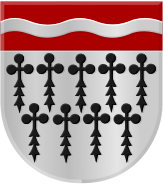
From medieval trading village to world capital of the oyster - the history of Yerseke is determined by the ebb and flow of the Oosterschelde.
Yerseke is first mentioned on 24 January 966, as "Gersika" in a charter of Emperor Otto I, and again on 27 July 980 as "Gersicha". It was long assumed the name came from a creek, but medieval copyists who didn't know the village likely made an error.
The motte castle on the village's west side is replaced by a new castle, 't Burchtje, home to the lords of Yerseke.
A devastating storm surge floods the area east of Yerseke — later known as the Drowned Land of South Beveland — and the moors west of the village. Only the St. Odulphus Church and the houses around it stay dry.
During the Revolt against Spain, Yerseke suffers looting and arson from both Sea Beggars and Spanish soldiers.
The government issues the first plots on the Oosterschelde seabed for oyster farming, and a new harbour is built; Yerseke grows into a centre of shellfish farming.
The first oyster pit is built on the outside of the Breedsendijk. The village grows so fast it becomes known as "the Zeeland Klondike", after the Canadian gold-rush town.
Mussel trade and auctioning develop; Yerseke becomes the centre of the Dutch mussel trade, home to the country's only mussel auction.
Oyster farming starts to struggle. Many Yerseke residents emigrate to the United States, especially to West Sayville, New York, where oysters were also farmed.
The 1953 North Sea Flood hits all of Zeeland hard and helps trigger the Delta Works.
On 15 July the new harbour opens: the Prinses Beatrixhaven. The old harbour section becomes the Prins Willem-Alexanderhaven.
The independent municipality of Yerseke is dissolved and merges with Rilland-Bath, Krabbendijke, Kruiningen and Waarde into the new municipality of Reimerswaal.
The Oosterschelde is closed off by the Oosterscheldekering storm surge barrier. Currents weaken and the tidal range drops to an average of 3.25 metres.
On 8 May the area officially becomes Oosterschelde National Park, at roughly 370 km² the largest national park in the Netherlands.
The Centre for Estuarine and Marine Ecology in Yerseke, formerly part of NIOO-KNAW, becomes part of the Royal Netherlands Institute for Sea Research (NIOZ).
Yerseke first appears in the written record on 24 January 966, as "Gersika" in a charter of Emperor Otto I, and again on 27 July 980 as "Gersicha". That makes the village at least eleven centuries old.
For a long time it was thought the name came from a creek — a fitting theory for a village so bound up with water. More likely, though, medieval copyists simply made an error, since they didn't know the village themselves and copied the name incorrectly. A prosaic explanation, but an honest one: not every mystery in Yerseke's history needs a romantic solution. The village arose on a creek ridge, a strip of higher ground amid the salt marshes, where the first inhabitants kept sheep among other things. That ridge offered something rare in this part of Zeeland: dry feet. While the surrounding land regularly flooded, the ridge at Yerseke stayed habitable, and that advantage shaped where the village could grow for centuries.
Yerseke was already a trading village in the Middle Ages. Residents traded wheat, madder (a red dye) and darink, salty peat that was cut for salt production.
That cutting, known as darinkdelven, took place in the moernering: the area where farmers dug up peat blocks to extract salt from them. The area where this happened for centuries is still called the Yerseke Moer today. It made money, but it also hollowed out the land — an early version of a pattern that would keep repeating throughout Yerseke's history: the water gives, and the water takes. A painting from around 1540, Darinck Delven, now hangs in the Stadhuismuseum in Zierikzee and still shows the different stages of that work in detail: from cutting the wet peat to drying and burning it for salt extraction. For anyone visiting the Yerseke Moer today, it's hard to imagine this quiet wet-meadow landscape was once a busy workplace.
’t Burchtje was the castle built around 1430 on the western side of Yerseke, replacing an older motte castle. It was the seat of the lords of Yerseke.
Yerseke was no sleepy backwater at the time: the village actively rivalled the nearby towns of Goes and Reimerswaal, and the lords of Reimerswaal even held a seat in Yerseke. Little physical trace of the castle remains, but the name ’t Burchtje lives on as a reminder of a village that once had its own noble government.
The St. Felix Flood of 1530 submerged the area east of Yerseke, since known as the Drowned Land of South Beveland, and also swallowed the moors west of the village.
Of all Yerseke, only the St. Odulphus Church and the houses immediately around it stayed dry — literally an island of stone amid the water. It's one of the clearest examples of how closely prosperity and ruin lay together in this corner of Zeeland: the same sea that made peat-cutting and later shellfish farming possible could claim a large part of the land in a single stormy night.
During the Dutch Revolt against Spain (1568–1648), Yerseke suffered looting and arson from both Sea Beggars and Spanish soldiers.
A vulnerable coastal village on a strategic shipping route was rarely a peaceful place to live in wartime, whichever side was doing the plundering. The exact extent of the damage isn't recorded in detail, but the Revolt marks one of the more turbulent periods in the village's early history.
Around 1870 the government issued the first plots on the Oosterschelde seabed for oyster farming, introduced by a handful of well-capitalised industrialists. Within a few decades, Yerseke grew into the heart of Dutch oyster culture.
The clear, nutrient-rich, tidally driven water of the Oosterschelde proved ideal for farming. Want to know exactly how that farming works, from tile culture to depuration? Read the full story on oysters from Yerseke, including the first oyster pit from 1871. And the boom that followed, and the emigration that came after? That's on our page about the Zeeland Klondike.
In the late nineteenth century, mussel trading and auctioning developed into a second economic pillar alongside oysters. Yerseke grew into the centre of the Dutch mussel trade, home to the country's only mussel auction.
Mussel farming itself is actually much older than oyster farming: it dates back to the fifteenth century. But it was only with the rise of organised trade and auctioning that Yerseke firmly established itself as the place for mussels in the Netherlands — a position the village hasn't relinquished since. The mussel seed itself doesn't come from the Oosterschelde, incidentally: it's fished from the Wadden Sea and then sown on plots near Yerseke, where the mussels keep growing until they're ready for auction. Fishing used to be done with small, distinctive sailing vessels, the hoogaars and the hengst; today modern ships with advanced navigation equipment do the work. The whole chain, from mussel seed to auction, is covered in full on our page about mussels from Yerseke.
The 1953 North Sea Flood hit all of Zeeland hard and directly led to the construction of the Delta Works, including the Oosterscheldekering storm surge barrier that has protected the Oosterschelde since 1986.
For Yerseke that was a mixed blessing. The barrier ended the threat of new flooding, but it also changed the water itself: currents weakened and the tidal range dropped to an average of 3.25 metres. As a result, sand settles in the old channels without new sand being deposited on the sandbanks, causing them to slowly erode — a phenomenon known as "sand hunger". For shellfish farming, the tide, weakened as it is, remained intact: crucial for the oysters and mussels that are depurated and sorted in the oyster pits. Read more about that tide, Oosterschelde National Park and the phenomenon of sand hunger on our page about tides and nature.
Until 1840, Yerseke's harbour consisted of no more than a few loading points on small dams. After stepwise expansions, the current harbour opened on 15 July 1965: the Prinses Beatrixhaven, with the older section becoming the Prins Willem-Alexanderhaven.
The rise of oyster farming around 1870 made a first new harbour necessary, with further expansions in 1883 and 1898. Plans for a larger harbour from 1938 stalled when the Second World War broke out, and in the 1950s the looming closure of the Oosterschelde created fresh uncertainty — until the decision was made to build an open Oosterscheldekering, which removed that threat. Since then, Yerseke has also been home to a notable research institute: the Centre for Estuarine and Marine Ecology, part of the Royal Netherlands Institute for Sea Research (NIOZ) since 2012.
Since 1 January 1970, Yerseke has been part of the municipality of Reimerswaal, together with Rilland-Bath, Krabbendijke, Kruiningen and Waarde. The village combines a working fishing harbour with thriving tourism around its shellfish culture.
Visitors taste fresh oysters and mussels, sail past the oyster pits and discover the rich history of the village and shellfish culture at the Oosterscheldemuseum. Curious which families and companies are behind that shellfish culture? Read about the shellfish families and companies of Yerseke. And want to know exactly what these facts are based on? Check our sources page or read who makes this site.

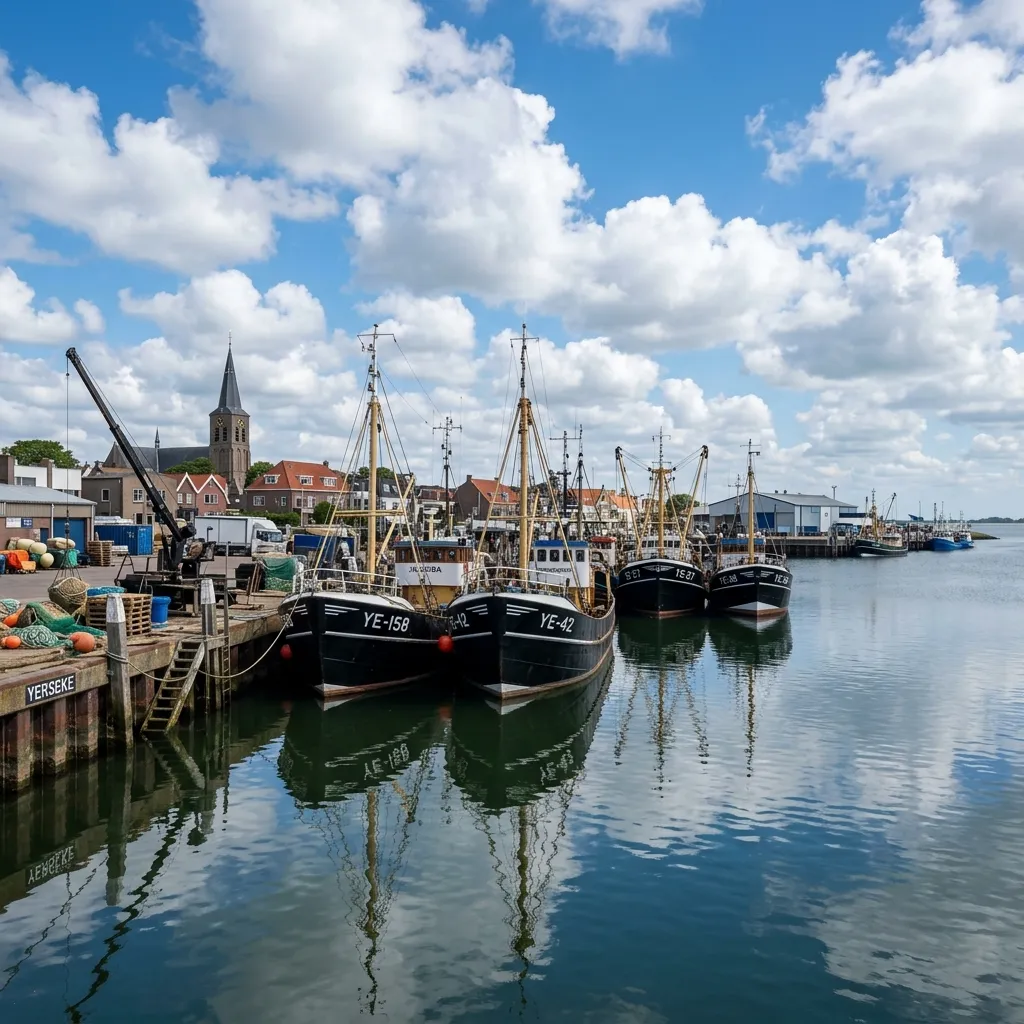


Yerseke lives to the rhythm of the ebb and flow of the Oosterschelde.
From harbourside hotels to holiday apartments: check current availability and prices for your stay in Yerseke.
View AccommodationsAffiliate link to our partner Expedia. We may receive a small commission, at no extra cost to you.