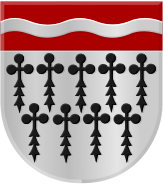
Yerseke Moer
Where farmers once dug peat for salt, a peat meadow now shows Yerseke's oldest recurring theme: the water gives, and the water takes.
Today the Yerseke Moer is a quiet peat meadow and Natura 2000 site. That calm is deceptive: the area was shaped by centuries of intensive digging. Farmers cut peat here for salt extraction, work that paid the village's bills while wearing down the land at the same time.
What is peat digging, and why did farmers do it in the Yerseke Moer?
Peat digging is cutting salt-bearing peat to extract salt from it. Farmers were already active here as peat diggers in the Middle Ages.
Yerseke was a trading village in the Middle Ages, with wheat and madder (a red dye) as other trade goods. Salt-bearing peat was the third pillar: cut from the ground and processed into salt. The area where this happened for centuries still carries the name today: the Yerseke Moer.
What exactly was the turbary?
The turbary was the whole process of peat digging: systematically cutting peatland in the Yerseke Moer to extract salt from it.
The word itself signals the scale: this wasn't occasional digging by one farmer, but organised activity that shaped the landscape of the whole region. The turbary determined what happened to this part of Zeeland for centuries, long before the oyster or the mussel took over that role.
What does the painting Darinck Delven, circa 1540, show?
The painting Darinck Delven, circa 1540, hangs in the Stadhuismuseum in Zierikzee and shows the various stages of the turbary as it was carried out around Yerseke for centuries.
From cutting the wet peat to drying and burning it for salt extraction: the painting captures a work process from nearly five centuries ago that is still recognisable in the Yerseke Moer landscape today. If you want to see the original: it's in the Stadhuismuseum in Zierikzee, not in Yerseke itself. That a painting from a neighbouring Zeeland town holds the best visual record of the Yerseke Moer also says something about how interwoven this part of Zeeland's history is: village boundaries were never much of an obstacle for the water, and apparently not for the painters who recorded it either.
Why did peat digging wear down the land?
Cutting peat for salt extraction paid the turbary economy well, but it also exhausted the soil and made the coast more vulnerable to flooding.
That's the thread running through the whole history of Yerseke: the water, and the way people exploited it, gives and takes at the same time. The same tension showed up at the 1530 Saint Felix flood, which drowned the area east of Yerseke and swallowed the marshes west of the village. Land already weakened by digging withstood a storm surge less well. In that sense, the Yerseke Moer isn't just a nature reserve but a landscape record of how thin the line between prosperity and vulnerability was here for centuries.
What is the Yerseke Moer today?
The Yerseke Moer is now a peat meadow and Natura 2000 site, with creeks that still recall the historical landscape of turbary and peat digging.
That makes the area a distinctive combination: nature protection on a site that owes its very shape to centuries of human intervention. Similar traces of that origin story, such as karrevelden and inlagen, also appear in the wider area around Oosterschelde National Park. Read more about that on our page about tides and nature.
How does the Yerseke Moer fit into the bigger story of Yerseke?
The Yerseke Moer is the oldest chapter in a story that later repeated itself: first with oyster farming after 1870, then with the mussel trade. Time and again, the relationship between people and water decides what happens to the village.
Where the turbary still worked with bare hands and the simple tools of the Middle Ages, the later oyster and mussel farming used the water itself as an ally rather than a resource to exhaust. Even so, the underlying pattern stays the same: a vulnerable coastal region where prosperity comes from the water almost by default, and where that same water can strike back just as easily, as it did during the 1530 Saint Felix flood or the 1953 North Sea Flood. For the full story of that tension, from medieval trading village to mussel capital, the history of Yerseke is the best place to start.
Where can you find official information for a visit to the Yerseke Moer?
For current, reliable information on access to and management of the Yerseke Moer, we point to the official area manager, Het Zeeuwse Landschap.
We deliberately don't invent walking routes, distances or car parks here: that kind of information changes, and an area manager keeps it more accurate than a tourism site ever could. See the official Het Zeeuwse Landschap area page for the most current practical details.
Key facts at a glance
| Aspect | Detail | Period |
|---|---|---|
| Activity | Peat digging (turbary) for salt extraction | Middle Ages |
| Yerseke's trade goods | Wheat, madder, salt-bearing peat | Middle Ages |
| Painting | Darinck Delven, Stadhuismuseum Zierikzee | Circa 1540 |
| Related disaster | Saint Felix flood, marshes west of Yerseke swallowed | 1530 |
| Status today | Peat meadow and Natura 2000 site | — |
Terms explained
- Peat digging
- Cutting salt-bearing peat to extract salt from it.
- Turbary
- The organised process of peat digging as it took place in the Yerseke Moer for centuries.
- Salt-bearing peat
- The raw material for salt extraction via turbary.
- Peat meadow
- A landscape type with peat soil and grassland, like today's Yerseke Moer.
Curious about the wider nature story of the Oosterschelde, including the tide and sand hunger?
Read about tides and natureSources
- Het Zeeuwse Landschap — official area manager of the Yerseke Moer
- Oosterscheldemuseum — history of the village and landscape
- Oosterschelde National Park — wider nature context
- Full source list for this site
Last updated: 9 August 2026
Book Your Stay in Yerseke
From harbourside hotels to holiday apartments: check current availability and prices for your stay in Yerseke.
View AccommodationsAffiliate link to our partner Expedia. We may receive a small commission, at no extra cost to you.